
Can you solve this rebus puzzle? Check Hints and Answer below.
Hints
Here are hints we believe can help you figure out the rebus puzzle on your own:
Hints
Here are hints we believe can help you figure out the rebus puzzle on your own:
- Hint #1: The answer is a common three-word English idiom.
- Hint #2: It describes someone or something that is receiving all the focus or interest from others.
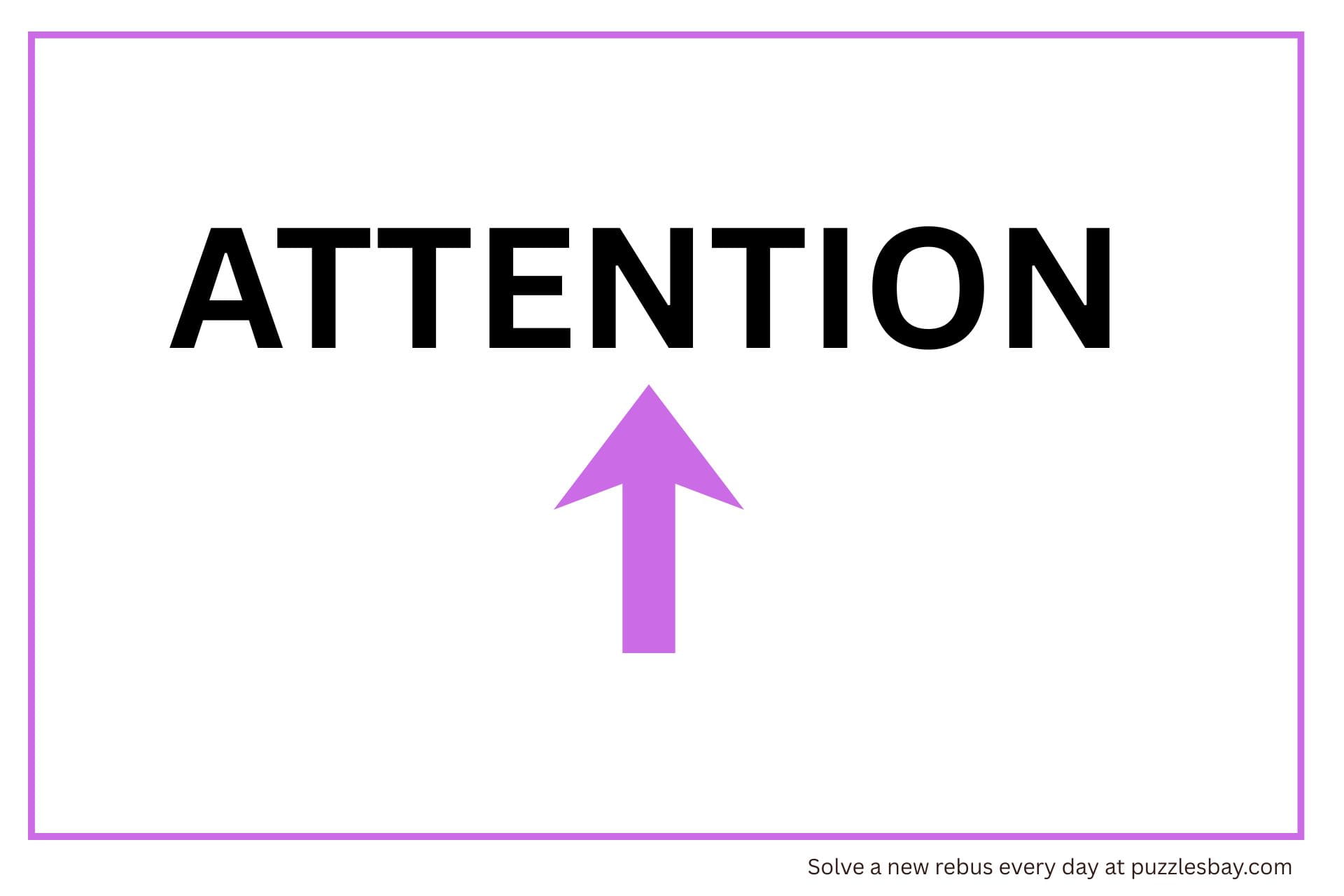
- Hint #3: Notice that the arrow points to the middle letter of the word ATTENTION—the placement is the key to solving the rebus.
Answer
Click To See the Answer
Answer: Center of Attention
What Is a Rebus Puzzle?
A rebus puzzle is a type of brain teaser that uses pictures, letters, numbers, symbols, and the arrangement of words to represent a word, phrase, idiom, or common expression. Instead of providing a straightforward clue, a rebus challenges you to think creatively and interpret visual hints to uncover the hidden meaning.
For example, the word HEAD written multiple times in a row may represent the phrase “heads up,” while the word MAN placed inside the word MOON could represent “man in the moon.” Similarly, a single picture combined with a few letters or numbers might spell out an entire phrase when read aloud.
Unlike traditional crossword puzzles or word searches, rebus puzzles rely heavily on visual reasoning and lateral thinking. The answer is often hidden in the size, position, color, direction, repetition, or spacing of the elements rather than their literal meaning.
Common Types of Rebus Puzzles
Rebus puzzles come in many forms. Some of the most common include:
- Word placement: The location of a word hints at the answer. For example, a word written above another may indicate “over” or “on top of.”
- Repetition: A word appearing several times can suggest “again,” “multiple,” “double,” or “too many.”
- Size differences: Large or small text may represent words like “big,” “little,” “tiny,” or “giant.”
- Pictures and icons: Images stand in for words or sounds.
- Letters and numbers: Individual letters or numerals are used because they sound like words (such as “4” for “for” or “2” for “to”).
- Missing or incomplete words: A missing letter or broken word often represents concepts like “without,” “broken,” or “missing.”
Why Are Rebus Puzzles So Popular?
Rebus puzzles are enjoyed by people of all ages because they combine logic, creativity, and wordplay into a single challenge. They’re often found in puzzle books, newspapers, classrooms, escape rooms, party games, and online brain teaser collections.
Besides being entertaining, rebus puzzles help improve several cognitive skills, including:
- Critical thinking
- Pattern recognition
- Vocabulary
- Problem-solving
- Attention to detail
- Creative thinking
Because most rebus puzzles can be solved in just a few moments, they’re perfect for quick mental workouts during breaks or while commuting.
Tips for Solving Rebus Puzzles Faster
At first glance, rebus puzzles can seem confusing because they rarely mean exactly what they show. With practice, however, you’ll start recognizing common patterns and solve them much more quickly. Here are some helpful strategies.
1. Look Beyond the Literal Meaning
The biggest mistake beginners make is interpreting every picture or word literally. Instead, think about what the arrangement might represent. Ask yourself whether the position, direction, or appearance of the words is trying to tell you something.
2. Pay Attention to Position
Where a word appears is often the most important clue. Words placed above, below, inside, outside, upside down, or beside another word frequently represent common prepositions like over, under, between, inside, outside, or around.
3. Notice Repeated Words
If the same word appears several times, it usually isn’t accidental. Repetition may indicate phrases involving “double,” “again,” “twice,” “many,” or “too much.”
4. Watch for Size and Formatting
Large text, tiny text, bold letters, different fonts, or unusual spacing are all deliberate clues. They may represent ideas such as “big,” “small,” “wide,” “narrow,” “spread out,” or “close together.”
5. Say It Out Loud
Many rebus puzzles rely on words that sound alike. Reading the letters, numbers, or pictures aloud can reveal hidden phrases that aren’t obvious when viewed silently.
6. Think of Common Expressions
Most rebus puzzles represent familiar sayings, idioms, movie titles, song names, or everyday phrases. If the puzzle feels strange, consider whether it matches a common expression you’ve heard before.
7. Break the Puzzle Into Parts
Instead of trying to solve everything at once, identify each individual element first. Figure out what each picture, letter, or word represents, then combine them into a complete phrase.
8. Don’t Overthink It
Many rebus puzzles have surprisingly simple answers. If you’ve come up with an overly complicated explanation, step back and consider whether there’s a more familiar phrase that fits the clues.
9. Practice Regularly
Like crosswords and other word games, rebus puzzles become easier with experience. The more puzzles you solve, the faster you’ll recognize recurring tricks and visual patterns.
10. Learn Common Rebus Clues
Many rebus puzzles use the same visual techniques repeatedly. Becoming familiar with these patterns can dramatically improve your solving speed.
Some common clues include:
- Words inside other words = “in” or “inside”
- Words above another = “over” or “on”
- Words below another = “under”
- Backwards text = “back” or “reverse”
- Upside-down words = “upside down”
- Broken words = “broken”
- Missing letters = “without”
- Repeated words = “again,” “double,” or “multiple”
The more of these patterns you recognize, the more quickly you’ll identify the intended answer.